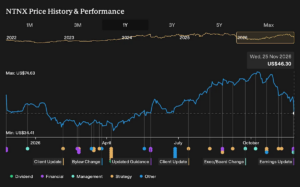
Wheaton Precious Metals shares gained 5.1% on Nov. 25, 2026, closing at $122.60 after falling as low as $111.21, according to Ainvest market data. The rebound left the stock up 4% for the year, while spot gold, at $3,531.61 an ounce, was down about 16%. U.S. markets were closed the next day for Thanksgiving.
Wheaton’s results help explain the gap. Although gold had fallen since the start of 2026, the average price Wheaton received for its mix of metals in the first nine months was still 64% higher than a year earlier. By the third quarter, however, its selling price had fallen 14% from the first-half average.
What Wheaton earns on an ounce
Wheaton finances partner mines upfront in exchange for the right to buy a share of their future production at a contracted price. It then sells the metal at market prices. The partner bears the costs of operating the mine, while Wheaton’s main cash cost per ounce is its payment on delivery. Some payments move with the market: for silver from the Antamina mine, Wheaton pays 20% of the spot price.
In its Nov. 5 report, Wheaton said it received $4,014 per gold-equivalent ounce (GEO) in the third quarter, down from $4,683 in the first half. The unit expresses sales of gold, silver and other metals on a common basis. At a cash cost of $548 per GEO, up from $452 a year earlier, Wheaton retained an 86% cash operating margin before depletion, corporate costs, interest and taxes.
For the first nine months, Wheaton received an average of $4,463 per GEO and sold 9.5% more ounces than a year earlier. Revenue rose 79.5% to $2.6 billion, operating cash flow increased 77.8% to $2.06 billion and earnings per share rose 68% to $3.38. Those gains reflect prices already received. Using the company’s disclosed third-quarter sales volume, Ainvest estimated that a decline in the realized price from $4,014 to $3,550 per GEO would reduce cash flow by about $89 million, or 14%. That is a sensitivity estimate, not company guidance.
Delivery timing complicates the revenue picture
Third-quarter revenue of $772 million was about 12% below the $876 million consensus tracked by Investing.com. Earnings of $0.903 per share missed the consensus by 11%. Wheaton reported production of 230,965 GEOs but sold only 192,270. At Sept. 30, it had 178,600 GEOs produced but not yet delivered, equivalent to 2.6 months of payable production and within its expected range of 2.5 to 3.5 months.
Wheaton’s full-year guidance of 860,000 to 940,000 GEOs is for production, not sales. With 583,129 GEOs sold through September, fourth-quarter sales would have to reach about 317,000 GEOs, 65% above the third quarter, for annual sales to match the midpoint of that production range. Deliveries of metal already produced could lift revenue even if prices fall, without indicating stronger demand. Those ounces are unhedged, however, so Wheaton has not locked in their selling price.
Debt adds interest-rate exposure
Wheaton paid $4.3 billion for BHP’s 33.75% share of Antamina’s silver, using cash and borrowing that included a $1.5 billion term loan and a draw on its revolving credit facility. At Sept. 30, Wheaton had $1.6 billion of floating-rate bank debt at an average effective rate of 4.89%. Quarterly finance costs rose to $25.1 million from $1.4 million a year earlier.
At the Nov. 25 close, the stock traded at about 21.6 times operating cash flow per share when the third quarter’s $1.42 was annualized. That calculation assumes the quarter’s cash flow repeats; it is not a forecast. Wheaton still projects production of 1.2 million GEOs by 2030, about 50% above 2025 levels. Higher production would give it more metal to sell, but the cash those ounces generate will depend on both the price Wheaton receives and when its partners deliver.