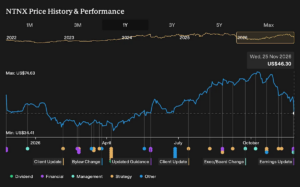
Swedish specialty fats maker AAK earned SEK 4.78 billion in operating profit in the 12 months through September 2026, about as much as in the preceding year. Yet by November 26, when its Stockholm-listed shares closed at SEK 171.60, the company had lost about 34% of its market value in 2026. Its latest quarter helps explain the gap: AAK sold as much product as it had a year earlier but earned 8% less operating profit per kilo.
AAK refines and blends vegetable oils for customers including chocolate makers, bakeries and dairy producers. Because it passes much of the cost of raw materials on to customers, sales can rise without any improvement in profitability. That happened in the third quarter: revenue rose 4% on flat volumes, while operating profit fell 8%. Operating profit per kilo shows how much AAK earns on what it sells after paying to run the business.
Where margins weakened
AAK’s reported operating profit per kilo rose from SEK 1.94 in 2023 to SEK 2.25 in 2024 and SEK 2.33 in 2025. Expensive cocoa butter made AAK’s plant-based substitutes attractive to chocolate manufacturers, while a shift toward specialty products and cost savings also helped. AAK’s long-term target is at least SEK 3 per kilo by 2030.
In the third quarter of 2026, AAK earned SEK 2.27 per kilo, up slightly from SEK 2.25 in the second quarter. The third quarter is usually stronger, however. Compared with the same quarters of 2025, the decline widened from about 5% to 8%.
AAK attributed the weakness in Chocolate & Confectionery Fats to more competitive pricing and a prolonged decline in chocolate consumption. The division still increased third-quarter volumes by 1%. In Food Ingredients, which accounted for 59% of group operating profit in the 12 months through September, AAK said a surplus of animal-based milk fat had reduced demand for plant-based alternatives. Bakery and foodservice volumes were also soft.

What the lower valuation implies
AAK’s enterprise value, which includes net debt, fell from SEK 72.2 billion at the end of 2025 to SEK 48.1 billion in late November 2026. That took its valuation from 15.3 times operating profit to about 9.9 times, the lowest multiple in the six years examined. The drop reflects a lower price for each krona of trailing profit rather than a comparable decline in profit itself.
One way to assess that price is to ask what earnings would support it at a higher multiple. At 12 to 15 times operating profit, the November enterprise value would imply annual operating profit of SEK 3.2 billion to SEK 4.0 billion. At sales volumes of about 2.02 million tonnes, that works out to roughly SEK 1.60 to SEK 2.00 per kilo, compared with the SEK 2.27 AAK earned in the third quarter. The range depends on the multiple investors use; it is not a company forecast.
Cash flow and the buyback
Operating cash flow rose to SEK 3.97 billion in the first nine months of 2026 from SEK 574 million a year earlier. Roughly 80% of the improvement came from working capital: it released SEK 489 million after absorbing SEK 2.23 billion in the comparable period. That swing strengthened cash flow without signalling a recovery in margins.
Excluding working-capital movements, estimated free cash flow was SEK 2.9 billion to SEK 3.1 billion in the 12 months through September. That covered the roughly SEK 2.43 billion combined cost of the SEK 5.50 ordinary dividend per share and the SEK 1 billion annual buyback about 1.2 times. A separate extraordinary dividend of SEK 3.85 per share was a one-off.
The distinction matters if margins fall further. In a scenario holding volumes and the cost base constant, operating profit of SEK 2.30 per kilo would leave free cash flow at about 1.17 times the ordinary dividend and buyback combined. At SEK 2.00 per kilo, coverage would slip to 0.98 times: the ordinary dividend would still be covered, but the two payments together would slightly exceed free cash flow. Fourth-quarter volumes and operating profit per kilo will offer a clearer test of whether margins are stabilising than the nine-month cash inflow alone.