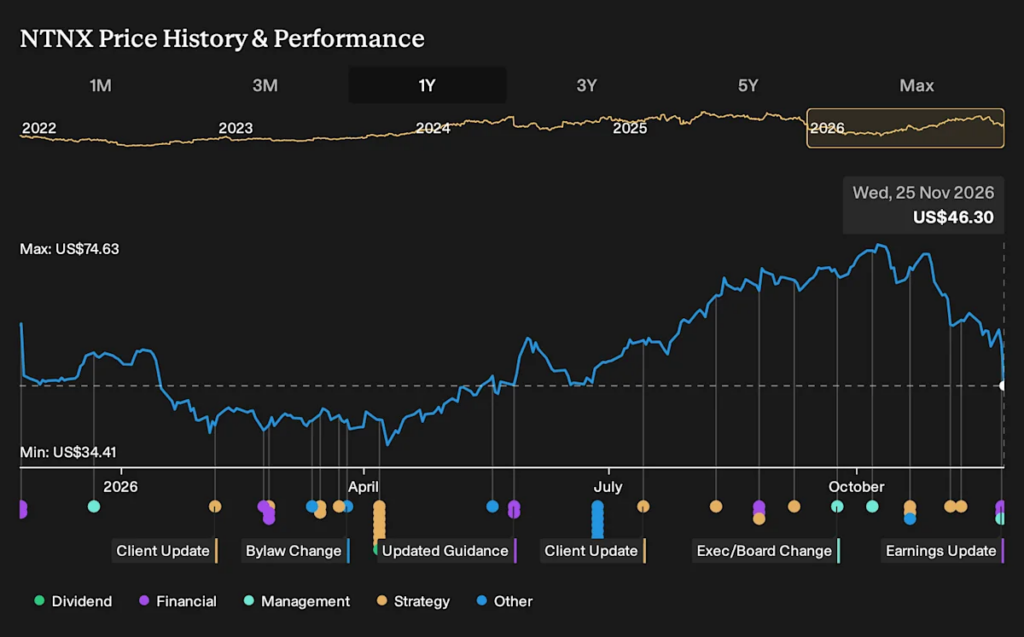
Nutanix shares fell 15% to $46.30 on Nov. 25, 2026, a day after the company reported a record quarterly non-GAAP operating margin and announced that CEO Rajiv Ramaswami would step down. The succession plan was only one piece of the announcement: total contract value bookings fell about 2% year over year, and Nutanix held its annual revenue forecast steady while raising its margin and free-cash-flow targets. The share-price move does not establish how much weight investors gave each development.
At the Nov. 25 close, Nutanix’s enterprise value was about 12.5 times the midpoint of its annual free-cash-flow forecast. Treating stock compensation as a cost to shareholders and allowing for a higher tax bill produces an estimated multiple closer to 20 to 24 times. That difference matters as the company steps up spending on sales and AI while looking for a new chief executive.
A sales handoff before the CEO transition
President and Chief Commercial Officer Tarkan Maner stepped down effective Oct. 2. Ramaswami took oversight of sales, marketing and customer experience, putting him in charge of winning new business shortly before the board announced its search for his successor.
Management attributed the bookings decline to customer and prospect account reassignments and the timing of large deals. No filing cited in the reporting linked the decline to Maner’s departure. CFO Rukmini Sivaraman said the unusually extensive account reassignments hurt new-customer additions in the quarter ended Oct. 31. She described the impact as “temporary and largely behind us” and expected Nutanix to add more new customers in the second quarter than in the first.
New customers account for much of Nutanix’s growth. Net dollar-based retention was 105%, meaning existing customers spent about 5% more. Against 15% growth in annual recurring revenue, that suggests roughly 10 percentage points of growth came from new accounts.
Under the terms in Nutanix’s Nov. 24 filing, Ramaswami will remain CEO and a director until his successor starts or April 30, 2027, whichever comes first. No successor had been named. He will then serve as an independent-contractor adviser through Sept. 30, 2027, at $133,333 a month. His equity awards will continue to vest except for a 2024 performance award. A separate $5 million cash award is conditional on his availability, completion of handoff milestones and not taking another executive role before the advisory term ends. He waived his rights under the executive severance policy and said there were “no plans to change any of the strategic priorities.”
The spending plan behind the margin forecast
First-quarter revenue rose 15.2% to $772.4 million, and free cash flow reached $209.3 million. The record 32.1% non-GAAP operating margin excludes stock compensation and certain other costs. Nutanix does not expect to sustain that margin throughout the year.
The company maintained its fiscal 2027 revenue forecast of $3.18 billion to $3.23 billion. The midpoint implies about 12% growth from fiscal 2026 revenue of $2.85 billion. Management projected second-quarter revenue of $820 million to $830 million, up about 14% year over year, followed by a mid-to-high single-digit decline from the second to the third quarter.
Nutanix forecast a second-quarter non-GAAP operating margin of 27% to 28%. Its full-year target of 24.5% to 25.5% implies a second-half margin of about 20% as it spends more on sales and AI.
What the $925 million cash-flow forecast leaves out
Using the 272.7 million shares outstanding on Oct. 13 and the Nov. 25 closing price gives Nutanix a market value of about $12.6 billion. Adding $1.35 billion in convertible notes and subtracting $2.47 billion in cash and short-term investments yields an enterprise value of roughly $11.5 billion, or 12.5 times the $925 million midpoint of free-cash-flow guidance.
Stock compensation does not require an immediate cash payment, but it can dilute existing shareholders. Nutanix recorded $357.7 million of stock-based compensation in fiscal 2026, equivalent to 12.5% of revenue. It spent $483.5 million repurchasing 9.4 million shares and paid $195.5 million in withholding taxes on vesting awards. Together those outlays equaled 81% of the year’s $841 million in free cash flow. Shares outstanding still rose 0.7%, as a $150 million private placement added 4.1 million shares.
Tax benefits also support cash flow. Nutanix paid $29.7 million in cash income taxes in fiscal 2026 and reported $675.4 million of non-GAAP operating income. It had $1.7 billion in federal net operating losses and $246 million in research credits. Its annual filing said the losses begin to expire in fiscal 2027.
Deducting an illustrative $350 million for stock compensation from guided free cash flow leaves $575 million, putting enterprise value at about 20 times that amount. Applying a normal federal tax rate to profit after stock pay could add an estimated $60 million to $90 million to the annual tax bill. At the upper end, estimated earnings attributable to owners fall to about $485 million, for a multiple near 24. These are valuation assumptions, not company forecasts.
The board’s choice between repurchasing shares and investing in growth turns partly on whether additional spending brings in customers. Contracted revenue not yet recognized rose about 24% to $3.3 billion, but average contract duration also lengthened from 3.1 years to 3.4. The larger backlog therefore reflects longer commitments as well as business volume. Whether new-customer additions recover in the second quarter, as Sivaraman expects, will offer a nearer-term test of the sales operation the next CEO inherits.