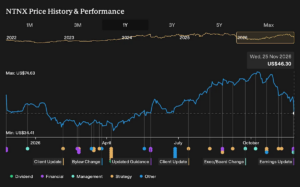
On November 20, 2026, Strategy’s common stock had a market value of $34.7 billion, while the 850,849 bitcoin in its treasury were worth about $50.5 billion. That put the shares at roughly 69 cents for every dollar of bitcoin. But common shareholders have a claim on what remains after convertible noteholders and preferred shareholders are paid, not on the full $50.5 billion.
Strategy put its “net reserve” at $35 billion without publishing a detailed methodology. If that figure represents the value left for common shareholders after accounting for senior claims and $4.8 billion in dollar assets, the net claims ahead of the common stock amounted to about $15.5 billion. Adding them to the $34.7 billion market capitalization gives an estimated enterprise value of $50.2 billion, close to the value of the coins.
Other measures also showed a smaller discount than the headline comparison. Under a definition it adopted in July, Strategy’s dashboard reported a multiple of 0.97 times net asset value, based on the company’s own reserve estimate. JPMorgan put its enterprise-value multiple at 0.88 on November 25, which it called a record low. The figures use different methods, but both account for financing claims that the 0.69 ratio leaves out.
Strategy sold common shares to retire preferred stock
Strategy’s November 23 filing shows how the financing affects shareholders. In the week ended November 22, the company raised $176.7 million by selling 1.93 million common shares. It used $147 million of those proceeds to repurchase STRC, its variable-rate perpetual preferred stock, and $29.6 million to buy 457 bitcoin. Across all funding sources, preferred repurchases that week totaled $211.8 million, more than seven times the bitcoin purchase.
The board raised its authorization to repurchase digital credit securities to $4 billion after Strategy spent $2.88 billion of its previous $3 billion authorization. A separate $1 billion authorization to buy back common shares remained unused, CryptoSlate noted. Michael Saylor said retiring about $2.9 billion of credit had saved $353 million in annual dividends.
That choice helps explain why two measures of bitcoin per share moved in opposite directions. With nearly two million new shares issued and only 457 coins added, gross bitcoin per diluted share fell 0.37%, from 186,082 to 185,392 satoshis. Yet Strategy reported that net bitcoin per share rose by 6.1 satoshis: retiring preferred stock reduced the claims ahead of each common share.

What the net gain leaves out
Strategy reported a cumulative net gain of 584 satoshis per share over 13 weeks, equivalent to about 0.3% of the 185,392 satoshis of gross holdings per share at the end of the period. Saylor’s separate $199 million “Net BTC Gain” figure was measured before preferred dividends. At a 12% rate, $7.765 billion of STRC alone implies annual dividends of $931.8 million.
Saylor said Strategy’s $4.8 billion in dollar assets could cover 3.4 years of dividends, interest and operating costs at then-current levels. That implies a combined annual bill of about $1.4 billion, or roughly 4% of the reported net reserve. The bitcoin itself is unencumbered: a fall in its price reduces the value left for common shareholders, but does not give a lender the right to call the coins.
That distinction matters as index investors prepare for a change. On November 11, MSCI decided to remove Strategy from its U.S. and global standard indexes at the November 30 close. JPMorgan estimated the exclusion could prompt about $2.8 billion of passive selling. That was a projection of sales of Strategy shares, not a requirement for the company to sell bitcoin.
A return to a premium over net asset value would make it easier for Strategy to issue shares and buy more bitcoin per existing share. In November, however, the company directed far more money toward reducing its preferred dividend bill than toward adding coins. For a common shareholder, the relevant comparison is the share price against the assets remaining after those preferred and debt claims—not against the gross value of the treasury.