On Nov. 24, 2026, Global Growth Insights estimated that the global data center market would grow from $190.39 billion in 2025 to $284.27 billion in 2035, a compound annual rate of 4.09%. Two days later, a syndicated article on Yahoo Finance identified Equinix as a beneficiary. The forecast, however, does not show how much of that spending will go toward the two services Equinix sells: space and power in shared facilities, and connections between customers’ networks.
Equinix expects revenue of $10.325 billion to $10.365 billion in 2026, up roughly 12%. It also expects adjusted funds from operations (AFFO) per share, a measure of cash earnings used by real estate investment trusts, to rise 11% to 12% on a normalized, constant-currency basis. That guidance covers one year, not the next decade.
What the market estimate measures
Global Growth Insights lists hosted services and public cloud services among its market segments. Yet Synergy Research put enterprise spending on cloud infrastructure services alone at $168 billion in the third quarter of 2026, up 55% from a year earlier. The figures measure different things, and the Global Growth Insights release does not make clear how narrowly it defines cloud services. That limits its usefulness as a benchmark for a data center landlord.
Equinix’s revenue guidance amounts to about 5.2% of the publisher’s $198.18 billion market estimate for 2026. If Equinix revenue grew at 4.09% annually from that base, it would reach about $14.8 billion in 2035. Sustaining 11% to 12% annual growth instead would put revenue at $26.5 billion to $28.7 billion, equivalent to 9.3% to 10.1% of the projected market. Those are illustrative scenarios, not company forecasts. Given the differences in what the two revenue figures cover, the percentages are not reliable estimates of market share.
What customers are leasing
Equinix’s third-quarter results offer more direct evidence of demand. Colocation, its business of renting space and power, generated $1.826 billion of its $2.571 billion in revenue, up 11.5% year over year. Interconnection revenue rose 10.2% to $465 million. Equinix added a net 6,900 connections in the quarter, bringing the total to more than 500,000. Prices on new leases rose 12% year over year, while quarterly churn was 1.7%.
Equinix says it has about 3 gigawatts of developable capacity, roughly 80% in its top 25 metropolitan markets. It planned to deliver more than 13,000 cabinets in the fourth quarter of 2026, with more than 20% already pre-sold. About 15% of its 2027 retail capacity was pre-sold. With full-year cabinet deliveries expected to exceed the original plan by nearly 40%, Equinix is committing capital before it has signed customers for much of that capacity.
Industry conditions help explain that decision. Property firm JLL reported 1% vacancy in North America and 25 gigawatts of absorption in the first half of 2026, double the year-earlier figure. But industry demand does not guarantee that Equinix can deliver a particular facility on time: grid connections, permits and construction schedules also determine when it can start collecting rent.
The cost of building ahead of leases
Equinix plans $4.71 billion to $5.69 billion in non-recurring capital spending for 2026, excluding its xScale ventures and real estate acquisitions. That exceeds its projected AFFO of $4.34 billion to $4.38 billion even before the $2.04 billion dividend. After dividends, about $2.3 billion of AFFO remains, leaving roughly $2.4 billion to $3.4 billion of the capital program to fund through borrowing and joint-venture capital. AFFO is useful for comparing real estate trusts, but it does not deduct most development spending.
According to Equinix’s third-quarter filing, debt principal rose from $21.4 billion at the end of 2025 to $25.2 billion on Sept. 30, 2026. After cash and short-term investments, net debt stood at $21.6 billion, about 4.1 times the midpoint of its adjusted EBITDA guidance. Its blended borrowing cost over the first nine months was approximately 3.3%. On Nov. 9, it issued €2.5 billion of senior notes with coupons ranging from 4.15% for the 2028 maturity to 5.45% for the 2038 maturity. Existing debt matures over several years, so higher rates affect interest costs gradually as Equinix refinances.
Some expansion will not appear in consolidated revenue. Equinix owns 20% of its xScale joint ventures and contributed $869 million for a 34% stake in Nordic data center operator atNorth. Both investments are unconsolidated: Equinix participates in their profits without recording their revenue as its own. It has also committed to lease a minimum amount of atNorth capacity by 2030, though its filing described the amount as “not currently determinable.”
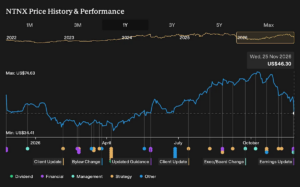
At the Nov. 25 close of $978.22, Equinix traded at about 22.3 times the midpoint of its 2026 AFFO guidance. For shareholders assessing what that price buys, the share of new cabinets leased, the prices customers pay and the interest expense on new debt are more informative than a global spending projection. They show not only whether Equinix is growing, but how much of that growth is left after financing its facilities.