Nvidia expects $130 billion in fiscal fourth-quarter revenue, give or take 3%, without counting any sales of data-center computing chips to China. The question ahead of CEO Jensen Huang’s Dec. 3, 2026, appearance before the Senate Banking Committee is how much business Nvidia could lose elsewhere. U.S. licensing rules now cover some overseas data centers that buy its chips and rent computing power to Chinese firms.
Where Nvidia and Jefferies disagree
On Nov. 16, the Commerce Department’s Bureau of Industry and Security published an interim rule requiring a license before a data center anywhere can receive advanced U.S. chips if it rents large amounts of computing power to Chinese firms. The rule also adds licensing requirements for shipments to Singapore, Malaysia, Indonesia, Thailand and Brazil. Data centers already serving affected customers have 90 days to apply, a window that runs into mid-February 2027.
Jefferies estimates the rule could reduce Nvidia’s 2027 data-center revenue by $44 billion to $62 billion. For comparison, Nvidia disclosed $2.4 billion in licensed Hopper data-center chip sales to China, including H200 chips, in its fiscal third quarter. That was about 2.2% of its $107.6 billion in quarterly data-center revenue. On Nov. 17, then-interim CEO Colette Kress told analysts Nvidia was no longer shipping those products to China.
Kress said demand from other buyers was strong enough to keep total revenue from falling as a result of the controls. Management raised its fiscal 2028 growth outlook from 70% to about 75% and said it had accounted for the rules. The difference between that assessment and the Jefferies estimate turns on whether other buyers can absorb the affected orders, and at what price.
Nvidia reported third-quarter revenue of $115.8 billion, up 103% from a year earlier. Its $130 billion forecast implies 12.3% growth from that quarter, but the fourth quarter has 14 weeks rather than 13. At the forecast midpoint, weekly revenue would rise about 4.2%, from $8.91 billion to $9.29 billion. Nvidia also expects gross margin of 71% to 72%, down from 74.8% in the third quarter. That gives investors a benchmark for judging not just whether sales hold up, but how profitable they are.
What the Senate can examine
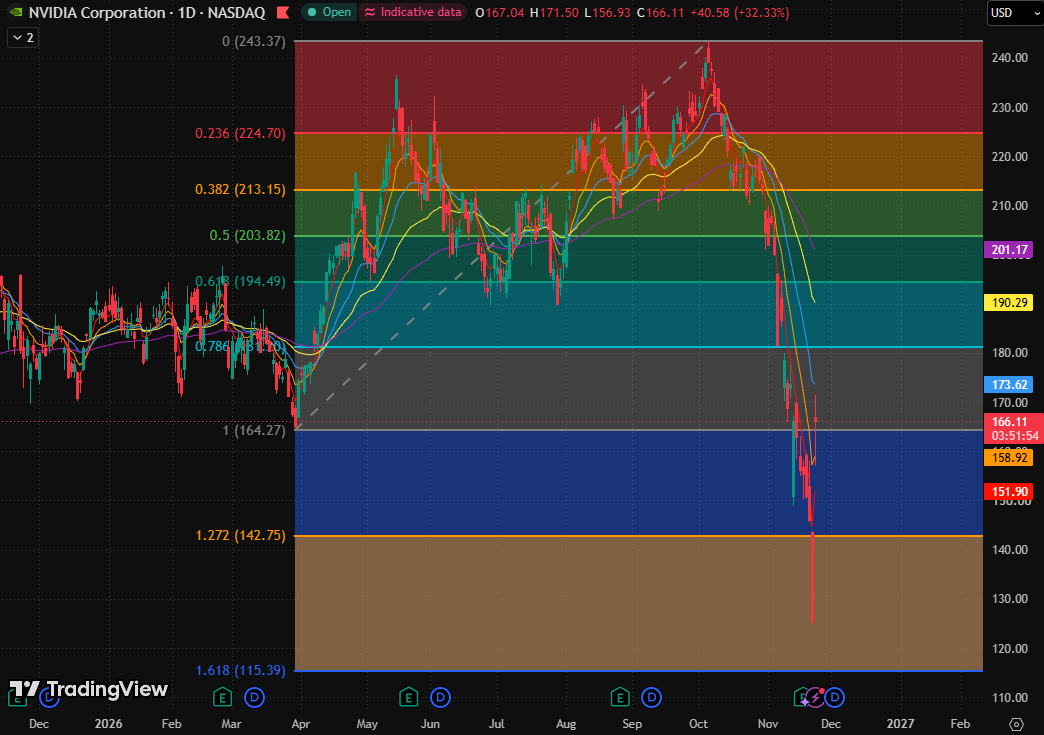
Nvidia’s board reinstated Huang as CEO on Nov. 23 after his resignation earlier in November following reports of extramarital affairs. The board said it had concluded his return posed no national-security risk. Nvidia shares rose 31.48% on the day of his reinstatement. By Nov. 27, they traded near $150, about 38% below their October record of $243.37.
Two reports raise questions about how Nvidia screens buyers. On Nov. 25, CBS News reported that Nvidia had sold advanced chips to at least two California-registered companies with Chinese-owned parents, including one Nvidia designated a preferred partner. On Nov. 27, Bloomberg reported that a GB300 NVL72 rack had been installed at a Shanghai data center linked to Alice Huang, whom reports had linked to the CEO. Bloomberg cited a serial number in a filing in which a Shanghai firm pledged the hardware as collateral for a 96 million yuan ($14 million) loan.
Shipping that system to China requires a U.S. license. Gigabyte, which assembled it, declined to identify its buyer. The reported collateral filing does not establish who shipped the rack or whether Nvidia violated export controls.
Sen. Elizabeth Warren said Huang’s reinstatement increased the urgency of passing bipartisan export-control bills. President Donald Trump said the attorney general had found no evidence of unlawful conduct and urged Nvidia to continue its internal export-control investigation. The bills Warren supports are distinct from the Commerce Department’s existing interim rule. Any further conditions on Nvidia’s sales remain a possible outcome, not an established consequence of the hearing.
The cost of securing future sales
Nvidia’s financial commitments make the question of replacement demand consequential. Its CFO commentary put supply and capacity purchase commitments at $390 billion, up $111 billion in one quarter, mostly because of multiyear memory purchases. Nvidia held $53.5 billion in cash and marketable securities at quarter-end. The commitments extend over time; they are not all bills due against that cash balance today.
Nvidia also disclosed $118 billion in guarantees, including up to $105 billion in credit support for land, power and buildings at an Ohio campus used by OpenAI under a 20-year lease. Some agreements are contingent: $32 billion in agreements with cloud providers take effect only after the customer secures financing, deploys capacity and Nvidia accepts it.
If buyers remain on waiting lists, securing scarce memory and capacity can help Nvidia fill their orders. UBS identified the opposite risk: Nvidia could become so committed to those purchases that it needs to keep financing customers to sustain sales. Receivables rose about $18 billion in the quarter, and average collection time increased from 60 to 64 days. Alongside sales and margins, that collection period will help show how quickly Nvidia’s reported growth turns into cash.