Micron Technology shares closed at $646.95 on Nov. 27, 2026, up 7.6% in a rally across memory and storage stocks. The gain came even as GF Securities, citing order cuts by Chinese cloud providers, reduced its forecast for DRAM contract price increases in 2027. It now expects quarterly gains of 6%, 3%, 0% and 0%, down from 10%, 7%, 5% and 3%.
GF kept Micron among its preferred stocks. It expects supply to remain tight through 2028 and said producers could cut output to defend minimum contract prices. The distinction matters for Micron: customers have committed to much of its near-term production, but the price it earns on each unit of memory helps determine how profitable that production will be.
Prices drove Micron’s earnings growth
DRAM, the working memory used in servers and PCs, accounted for $39.8 billion, or 73%, of Micron’s fiscal fourth-quarter revenue. Prices rose by a percentage in the high teens from the previous quarter, while the amount of DRAM shipped, measured in bits, grew by only a mid-single-digit percentage. The gap was wider in NAND flash storage: prices rose about 30% and bit shipments increased about 10%.
Quarterly revenue reached $54.2 billion, up 379% from a year earlier, and non-GAAP earnings reached $33.42 per share. Those earnings help explain why Micron’s valuation looks low even after a substantial share-price gain. At the Nov. 27 close, the stock was worth roughly 7.7 times its year-end 2024 price but traded at about 8.5 times trailing non-GAAP earnings. It was also 47% below its June 25, 2026 high of $1,213.56.
What the contracts protect
Micron says it has sold about 75% of its 2027 output. Its 26 strategic customer agreements are take-or-pay contracts: customers must purchase the committed volume or pay for it. The agreements cover more than 35% of estimated revenue through 2030 and represent about $150 billion in revenue still to be delivered at minimum prices. Customers have committed $32 billion, mostly in cash deposits.
About three-quarters of the contracted revenue has a defined pricing framework, most of it with both floors and ceilings. Management expects margins at floor prices to remain meaningfully above previous cycle peaks. The contracts do not, however, set prices for all of Micron’s output or guarantee a return on its new factories.
When new supply arrives
Micron spent $30.7 billion on capital expenditures in the preceding 12 months. It plans to spend about $25 billion in the first half of fiscal 2027 alone and more in the second half. Most of the increase is for construction rather than equipment, so much of that spending will not immediately add chips to the market.
Micron expects its first Idaho plant to begin wafer output in mid-2027, when its Tongluo facility in Taiwan is also due to start shipping meaningful volumes. Its second Idaho plant and a Japanese DRAM factory are scheduled to begin production in late 2028. A new NAND plant in Singapore is due to start in the second half of 2028.
Forecasters disagree on when supply will catch up. Micron management expects fiscal 2027 and 2028 to be tighter than fiscal 2026. TrendForce expects DRAM contract prices to flatten in the second half of 2027 and decline in early 2028. BNP Paribas brought its estimate for supply and demand to reach balance forward by a year, to mid-2027, and cut its Micron price target from $1,700 to $775.
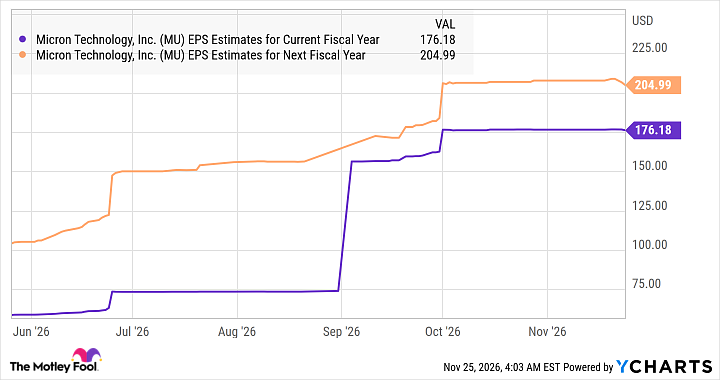
At the Nov. 27 close, Micron traded at about 3.7 times TIKR’s fiscal 2027 consensus earnings estimate of $176.18 per share. That multiple depends on profits that Micron has yet to earn. The next opportunity to assess the forecast comes on Dec. 17, when Micron is scheduled to report fiscal first-quarter results. Management guided to revenue of $61.5 billion, a gross margin of 86.25% and earnings of $38.15 per share. It also expects revenue to rise each quarter of fiscal 2027. The second-quarter outlook will offer an early test of that expectation; shipment volumes and pricing will help explain any growth.