Infleqtion (NYSE: INFQ) said on September 24, 2026, that it had entangled 30 logical qubits using 80 atoms, a quarter ahead of schedule. That works out to about 2.7 physical qubits per logical qubit, well below the Colorado company’s target of 10. But the experiment measured how densely Infleqtion could encode quantum information, not how much hardware it would take to run a long calculation reliably.
For investors, the more consequential numbers concern the machine Infleqtion aims to build by 2028. On a November 16 earnings call, its chief technology officer said the system could need “as few as 2,000 physical qubits.” The company’s published roadmap lists 10,000 for the same 100-logical-qubit target. Infleqtion’s public materials do not reconcile the two figures.
What the 80 atoms did
A logical qubit stores quantum information across multiple physical qubits to protect it against errors. Infleqtion used ten blocks of eight atoms, each encoding three logical qubits. The code used to prepare the state could correct a single error. The code used in the experiment could detect a single error but generally could not correct it. A lost atom was an exception: the machine knew where the loss had occurred.
According to the CTO, the experiment involved about 1,000 physical operations but only one round of error correction and detection. Runs with detected errors were discarded. A separate step recovered missing measurements from atom loss, quadrupling the number of usable runs at some cost in accuracy. That trade-off matters commercially: discarded runs consume machine time even when the encoding uses few atoms.
The result extends a progression from two logical qubits in 2024 to 12 in 2025 and 30 in 2026. It does not establish that those 30 qubits can sustain a long computation. As of late November 2026, the full paper promised in September had not appeared publicly; the available technical details came from the company’s blog, earnings call and roadmap.
Why the atom count changes the economics
Infleqtion’s roadmap associates its 2024 demonstration of two logical qubits with 1,600 physical qubits. It lists 4,000 physical qubits for the 2026 milestone even as it describes the experiment as using 80 atoms. For 2028, the CTO’s lower figure implies 20 physical qubits per logical qubit, compared with 100 on the roadmap. The roadmap retains that 100-to-one ratio for its 2030 “utility scale” target of 1,000 logical qubits.
One possible explanation is that the figures count different things: atoms in the encoding blocks, atoms used during computation, or capacity across a full machine, including replacements. A neutral-atom processor also needs empty sites through which atoms can move. Infleqtion has not confirmed that explanation. The distinction matters because a system supporting 10,000 atoms rather than 2,000 places different demands on its lasers, optics and vacuum equipment. A fivefold difference in atom count is not an established fivefold difference in cost.
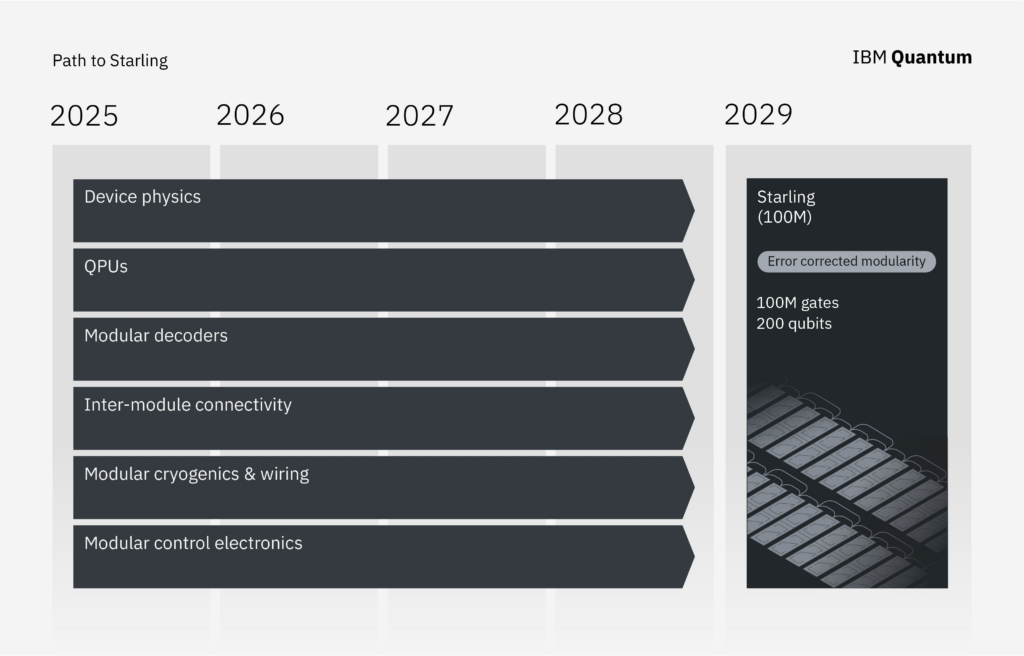
Competitors’ results illustrate why density alone is a poor benchmark. Quantinuum reported 99.9995% logical fidelity on its Helios machine, equivalent to five errors per million operations, using 10 physical qubits per logical qubit with one code and up to 37 with another. Infleqtion reported per-logical-qubit success rates of 99.9% and 99.2% in its experiment. Neither company had a fault-tolerant computer on the market. IBM, meanwhile, targets 200 logical qubits and 100 million operations for its Starling system in 2029; those are goals, not demonstrated results.
The business behind the roadmap
Infleqtion went public through a SPAC merger in February 2026. The deal was announced at a $1.8 billion valuation before the $540 million it raised. On November 25, the shares traded at $6.49, giving the company an equity value of about $1.47 billion, according to S&P Global Market Intelligence data published by StockAnalysis. That was roughly 33 times the low end of its 2026 revenue guidance, or about 20 times after subtracting its reported $560 million in cash.
Infleqtion reported third-quarter revenue of $9.1 million, up 25% from a year earlier. Revenue for the first nine months rose 57% to $32.6 million. Management maintained its 2026 forecast of at least $45.1 million and said it expected computing to account for a meaningfully larger share of the business in 2027. The contracts it highlighted were in sensing: NASA expanded a gravity-sensor contract by $20 million to $40 million, a UK award for an atom-based radio-frequency sensor was worth about $12 million, and the US Navy was testing an Infleqtion atomic clock.
The company reported a quarterly GAAP operating loss of $34.5 million. Its non-GAAP loss, excluding stock compensation, was $22.7 million. Operations consumed $16.3 million in cash, and capital spending was $5.2 million. Infleqtion reported no debt, although $28 million of its cash balance was temporarily held for payroll taxes related to option exercises. Terms were not final on up to $100 million in expected US Department of Commerce financing.
Infleqtion’s 2028 target pairs 100 logical qubits with one million reliable operations. The CTO identified three tasks still ahead: repeating error correction over many rounds, using codes that protect against more errors, and replacing atoms during a computation without losing the state. A demonstration that reports the reliable operation count alongside the full system’s atom count would tell investors much more about the hardware a customer would need to buy than September’s encoding ratio alone.