TRON processed about 1.10 billion transactions in the third quarter of 2026, up 33.7%, and reported $701.4 million in network fees. But that fee total is not income paid to holders of TRX, the network’s native token. Blockworks Research’s figures for the second quarter show the distinction: of $699.4 million in total network fees, about $90 million represented tokens removed from circulation, or roughly 13 cents per dollar.
That distinction matters for a token that traded near $0.30 on Nov. 27, with a market value of about $28.6 billion. That valuation was roughly 11 times annualized gross fees of $2.5 billion, but about 87 times the estimated annual burn of $328 million. Neither measure represents a cash payout to holders.
Why a transaction need not remove TRX from circulation
Transactions on TRON consume two resources: bandwidth and energy. Users can obtain them by locking up TRX through staking. If their staked resources fall short, they can burn TRX to cover the difference. Locking up tokens commits capital, a cost reflected in the broad fee measure, but it does not destroy the tokens. Only the burn reduces supply.
On Aug. 29, 2025, 25 of TRON’s 27 elected block producers approved Proposal #104, cutting the price of energy from 210 to 100 sun per unit. The 52.4% cut followed a rise in the dollar cost of transactions as TRX appreciated. Average transaction fees fell from 24.3 cents in 2024 to 7.8 cents in 2026. At the lower unit price, users would have to consume about 110% more paid energy to generate the same fees as before. A rise in transaction count alone does not establish that increase, particularly when users can draw on staked energy.
Unfolded, using data from DeFiLlama and Coin Metrics, tracked fees burned or otherwise captured by the protocol. Its measure averaged about $900,000 a day in 2026 through Nov. 23, down roughly 44% from $1.59 million a day in 2025.
Burns also fell short of new issuance. In the second quarter, TRON issued about 356.32 million TRX in block-production and voting rewards and burned about 269.45 million. That left supply 86.87 million TRX higher. Staking rewards came from newly issued tokens, not a distribution of network fees.
Stablecoin balances grew in a shrinking market
Figures from DeFiLlama and Luganodes put stablecoin supply on TRON at $93.7 billion, up $14.2 billion over a year. Its share of global supply rose from 26.8% to 33.1% as the global total fell from $297.8 billion to $282.5 billion. About 97.9% of the stablecoins on TRON were Tether’s USDT.
Those balances measure the stablecoins issued on the network, not assets backing TRX. For token holders, the relevant question is how much activity those balances generate and how often users burn TRX rather than rely on staked resources.
Tron Inc.’s shares carry a separate valuation
Nasdaq-listed Tron Inc., the former SRM Entertainment, reported holding more than 724.8 million TRX. At $0.30 per token, those holdings were worth roughly $218 million. Yahoo Finance put the company’s market capitalization at about $702 million on Nov. 27, just over three times the value of its tokens. That comparison does not value the company’s other business, which designs toys and souvenirs for theme parks.
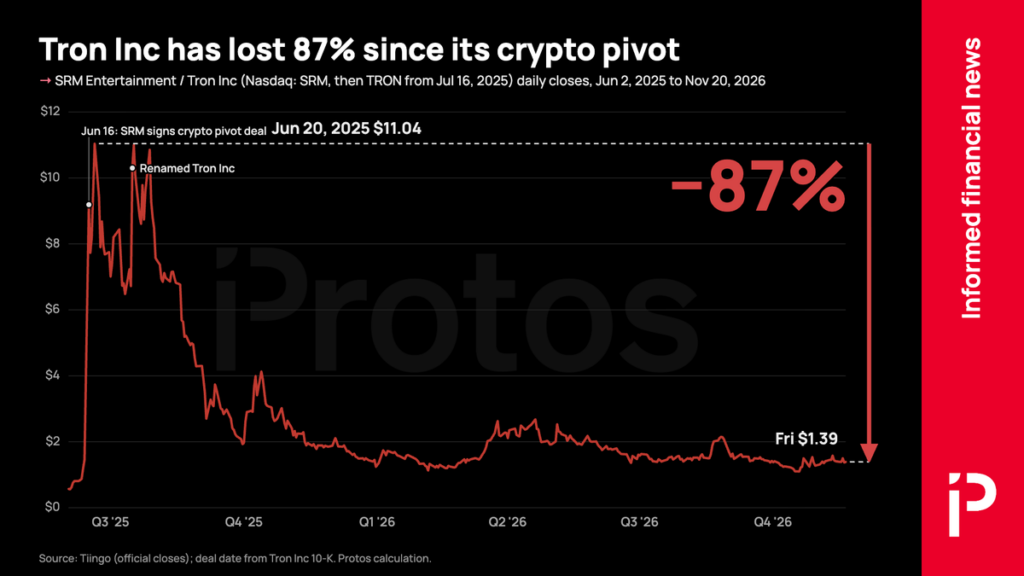
Recent token purchases were about $50,000 apiece, or 0.013% of the reported $372 million in daily TRX trading volume. The stock had fallen 87% from $11.04 in June 2025, when the company shifted toward crypto, to $1.39 the week before Nov. 28, 2026. Tron Inc. also warned in an SEC filing that cheaper network energy could reduce demand for its staking rentals. The same fee cut that made transactions less expensive for users can therefore affect both the company’s rental business and the amount of TRX burned.