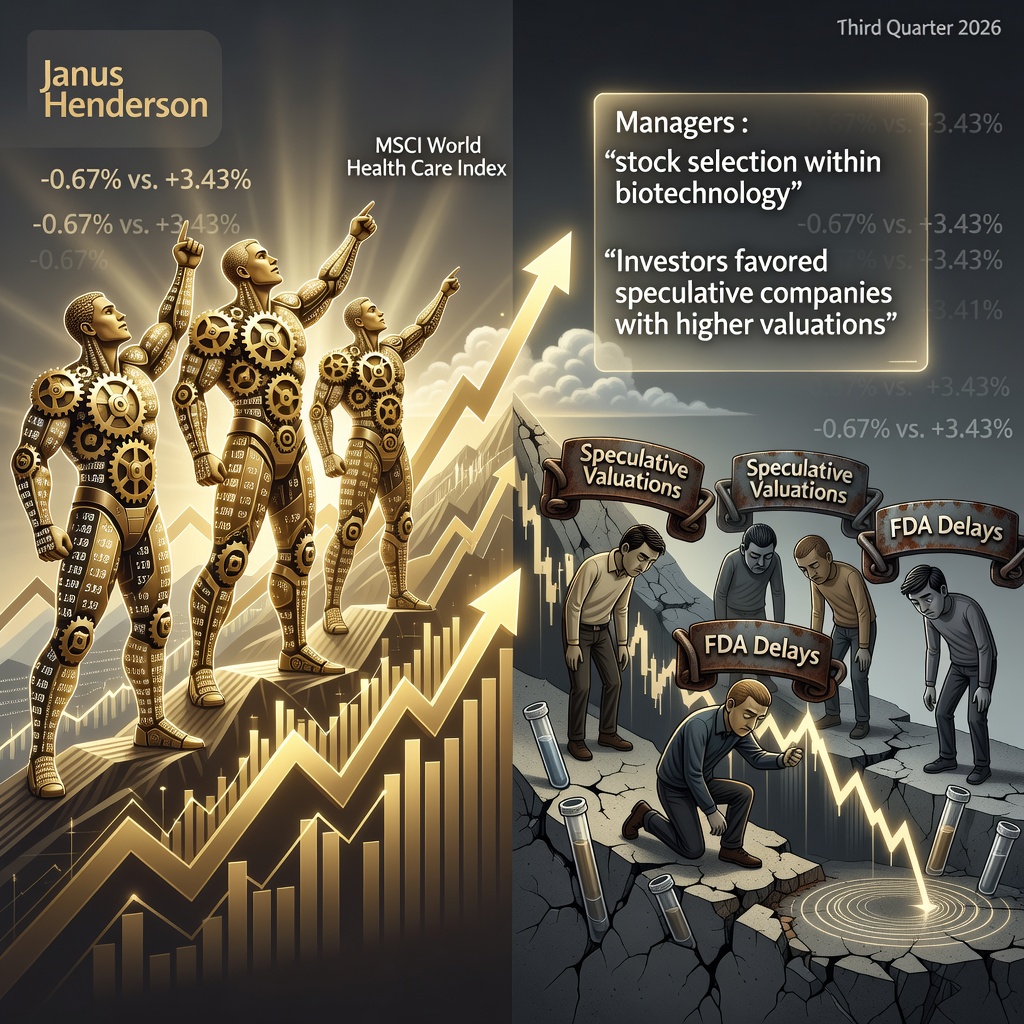
The Janus Henderson Global Life Sciences Diversified ADR Managed Account lost 0.67% before advisory fees in the third quarter of 2026, while its benchmark, the MSCI World Health Care Index, gained 3.43%. The managers attributed the 4.1-percentage-point shortfall primarily to “stock selection within biotechnology,” saying investors favored speculative companies with higher valuations.
Biotech had helped the strategy a year earlier. In the third quarter of 2025, it returned 8.26% against 3.01% for the index. The managers credited both their choice of biotech stocks and the larger share of the portfolio they allocated to the industry relative to the benchmark.
A closer look at the biotech holdings
At September 30, 2026, the mutual fund following the same strategy held 98 stocks. Its 10 largest holdings accounted for 43.7% of assets, led by Eli Lilly at 9.6%, Johnson & Johnson at 7.8% and AbbVie at 4.9%. But several smaller biotech positions help explain why the strategy fell even as large biotech stocks rallied.
An Ainvest analysis of eight biotech holdings, representing 11.9% of the mutual fund’s assets at quarter-end, estimated their weighted quarterly price decline at about 6.7%. That implies a drag of roughly 0.8 percentage points. The estimate used quarter-end mutual fund weights and unadjusted closing prices, so it is not an exact measure of those stocks’ contribution to the managed account’s return.
Mirum Pharmaceuticals fell 27% after the FDA delayed its review of a liver-disease treatment, despite net sales that beat forecasts. Not every biotech pick lost ground: Crinetics Pharmaceuticals rose about 127% between June 30 and its last trade in early September after agreeing to be acquired by Vertex in a deal valued at about $10 billion. The managers identified Crinetics as a leading contributor to relative performance.
The iShares Biotechnology ETF (IBB), meanwhile, gained 10.69% in the quarter. Its five largest holdings — Gilead, Amgen, Vertex, Regeneron and Moderna — accounted for about 37% of its assets and returned roughly 38% on a weighted basis. Moderna alone rose 175%.
The comparison changes with the benchmark and the time frame
The mutual fund’s large pharmaceutical holdings were not necessarily what set it apart from a passive portfolio. The iShares Global Healthcare ETF (IXJ), for example, had 11.5% in Lilly, compared with the mutual fund’s 9.6%. The smaller biotech positions were a more distinctive exposure. Costs also differed: the mutual fund charged 0.81% annually, versus 0.38% for IXJ and 0.44% for IBB. The managed account’s reported quarterly loss, by contrast, excluded the account holder’s advisory fee.
As of November 25, 2026, trailing one-year total returns were 20.12% for the Janus Henderson mutual fund, 17.86% for the iShares Global Healthcare ETF and 28.87% for the iShares Biotechnology ETF. Over those 12 months, the mutual fund beat the broader healthcare ETF by about 2.3 percentage points after fees but trailed the biotech ETF by 8.75 points.