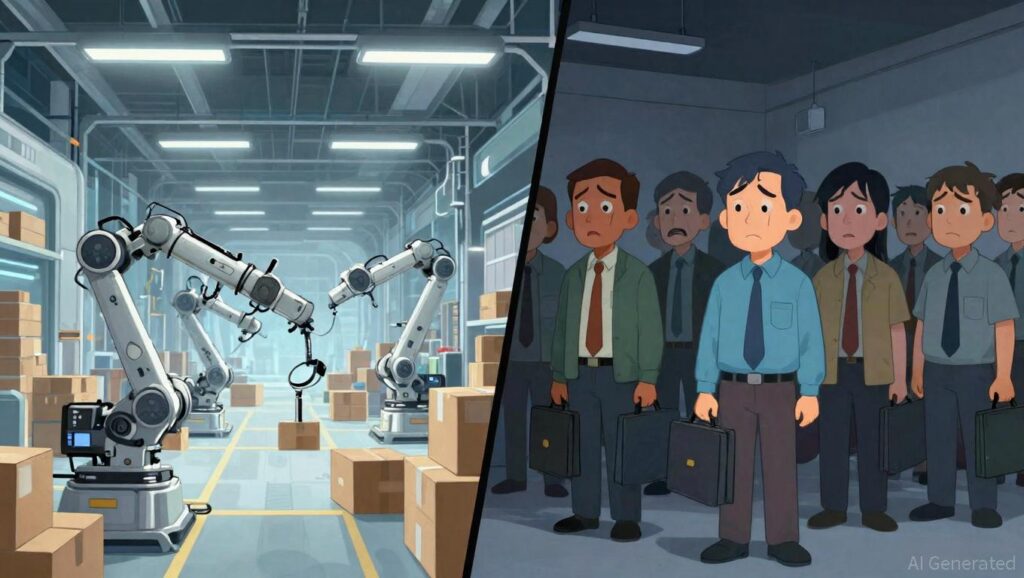
About 11 million U.S. workers may need to change occupations by 2035 as AI and automation reshape work, according to McKinsey research. An estimated 14% of those workers have a direct route into a growing occupation that would require little retraining and no pay cut. For workers earning less than $38,000 a year, that share is about 10%, compared with almost 40% in the highest wage bracket.
The findings, detailed in a Nov. 20, 2026, report from the McKinsey Institute for Economic Mobility, highlight a distinction that matters to employers as well as workers: the economy can add jobs without creating accessible alternatives for the people whose roles disappear. McKinsey projects 41 million jobs added and 36 million cut. The estimate of 11 million workers needing to move into different occupations comes from the McKinsey Global Institute study on which the report draws.
Where workers face the greatest disruption
McKinsey estimates that Black and Latino workers are about 20% more likely than White workers to need a new occupation by 2035. That is a relative difference, not a projection that 20% of Black or Latino workers will have to switch careers. Lower-wage workers are 7.6 times as likely as higher-wage workers to need a change.
The report attributes the racial differences to the tasks people perform. Automation is more readily applied to standardized work where errors are easy to detect and carry limited consequences, such as answering a routine billing question. Robotics also puts more physical tasks within reach. Physical work accounts for 39% of Latino workers’ hours and 35% of Black workers’ hours, compared with 26% for White workers.
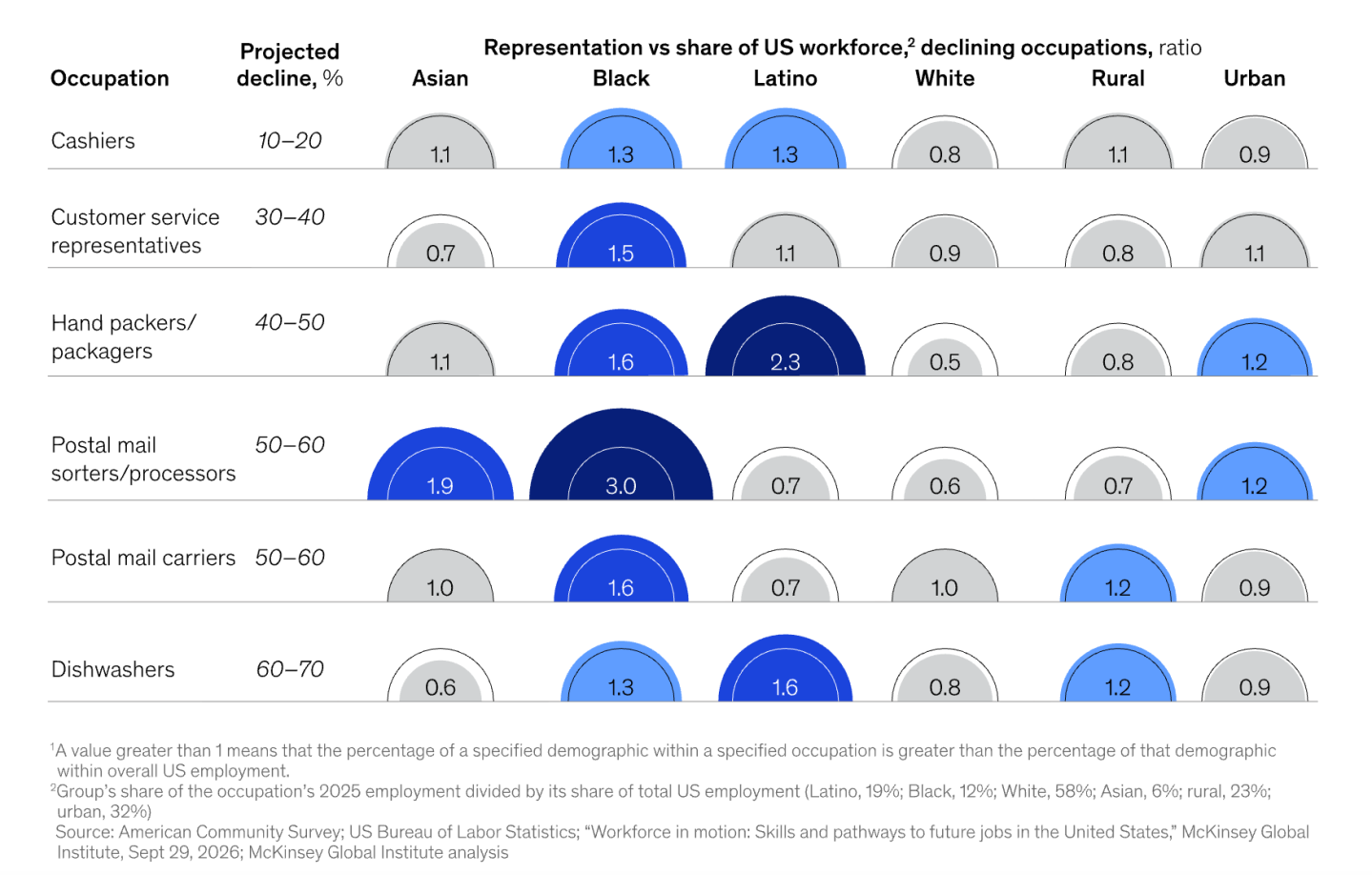
Black workers are overrepresented in six occupations the report identifies as declining: cashiers, customer service representatives, hand packers and packagers, postal mail sorters and processors, mail carriers, and dishwashers. Latino workers hold 43% of hand packer and packager jobs, or 2.3 times their share of the U.S. workforce. The report urges employers to train frontline workers and investors to seek hiring-tool bias tests that break out results by race, income and geography.
What labor savings mean for AI investment
The pressure to earn a return on AI spending is already substantial. JPMorgan strategists expect AI-related capital spending to nearly double to $1.4 trillion in 2027, Bloomberg reported. In a separate estimate, JPMorgan Wealth Management’s 2027 outlook put the end-customer spending needed to support the buildout at roughly $3 trillion annually by 2029. That figure describes what customers would need to spend, not what they have committed to buying.
Adoption has so far been easier to identify than profit. In McKinsey’s 2026 global AI survey, 89% of organizations reported regular AI use, but only 37% attributed any effect on earnings before interest and taxes to the technology. The latter share was unchanged from a year earlier.
Lower payroll costs could help individual companies earn a return. For businesses that depend on household spending, however, there is a second consideration: a worker who takes a pay cut may also spend less. Consumer spending accounts for about two-thirds of U.S. economic activity, according to U.S. Bank Asset Management’s Nov. 24 review. That exposure does not establish that automation will reduce overall demand; its effect depends in part on how readily workers find comparably paid jobs.
Chicago Fed President Austan Goolsbee offered a different view of which workers might feel the effects first. Speaking to Semafor in October 2026, he noted that many prominent AI applications involve knowledge work and that previous general-purpose technologies changed the makeup of employment without causing permanent mass unemployment. McKinsey’s projection of net job growth is consistent with that view. The more immediate question for employers and workers is how many of the new roles can be reached without an extended period of retraining or a loss of income.