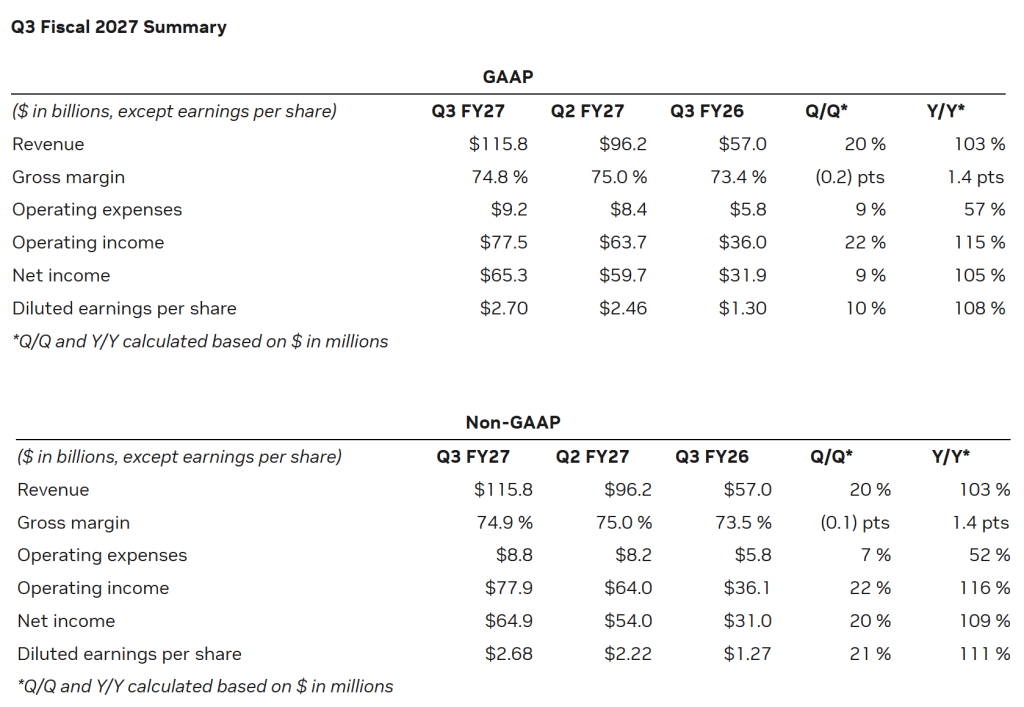
In a report published November 18, 2026, Nvidia said revenue for its fiscal third quarter ended October 25 reached $115.84 billion, up 103% from a year earlier and above market expectations of $109.1 billion. The results came amid a leadership change: board chair Harvey C. Jones said the board had not considered reinstating co-founder Jensen Huang as CEO.
Nvidia reported net income of $65.3 billion under U.S. generally accepted accounting principles, up 105% year over year. Non-GAAP diluted earnings per share rose 111% to $2.68, exceeding the market expectation of $2.48. Gross margin was 74.9%.
The company forecast fiscal fourth-quarter revenue of $130 billion, plus or minus 3%, compared with a market expectation of $125.1 billion. It projected a gross margin of 71% to 72%. Interim CEO Colette Kress also raised the company’s expected revenue growth rate for fiscal 2028, ending in January 2028, to 75% from 70%. She said the revised outlook accounted for data-center readiness, the strength and durability of end-customer demand, and customers’ ability to obtain financing.
Data-center revenue reached a record $107.6 billion, up 110% year over year and 21% from the previous quarter. It accounted for nearly 93% of total revenue and exceeded the market expectation of $101.9 billion. Nvidia’s edge-computing segment, which includes gaming and AI PCs, professional visualization, and automotive and robotics, generated $8.2 billion, up 42% year over year.
According to Xinhua, Nvidia announced on November 12 that Kress, previously executive vice president and chief financial officer, would serve as interim CEO after Huang resigned as president, CEO and director with immediate effect. The original report said Huang stated on social media hours before the earnings release that he was willing to return as CEO. On the earnings call, Jones said the board had not considered reinstating him.
The report also highlighted Nvidia’s financial commitments. At the end of the third quarter, the company held nearly $110 billion in marketable and non-marketable securities, with equity investments in private companies rising sharply from the preceding quarter. Commitments for future supply and capacity stood at $390 billion, up from $279 billion a quarter earlier; Nvidia said the increase was mainly related to multiyear memory-supply purchase agreements. Its commitments to newer cloud providers through 2032 totaled $32 billion. Kress said those commitments would take effect only after the providers secured financing, bought data-center infrastructure, deployed the computing capacity and passed Nvidia’s acceptance process.
The report said Nvidia shares closed November 18 down 0.44% at $155.46, giving the company a market value of $3.75 trillion. Shares were down more than 17% for the year at that point, while the stock rose more than 4% in after-hours trading following the earnings release. FactSet data cited in the report showed that, before earnings, 56 of 72 analysts rated the stock a buy or outperform, 15 rated it hold and one rated it sell. At least 11 Wall Street brokerages or research firms had downgraded their ratings since November 11, according to the report.