Lenovo opened its Black Friday sale on November 25, 2026, with IdeaPad laptops starting at $449.99 and select ThinkPads below $1,000. The discounts come in the company’s biggest device quarter of the year, as memory costs are expected to rise again. The stakes extend beyond PCs: Lenovo’s device division still earned more operating profit in the September quarter than its fast-growing server and storage business.
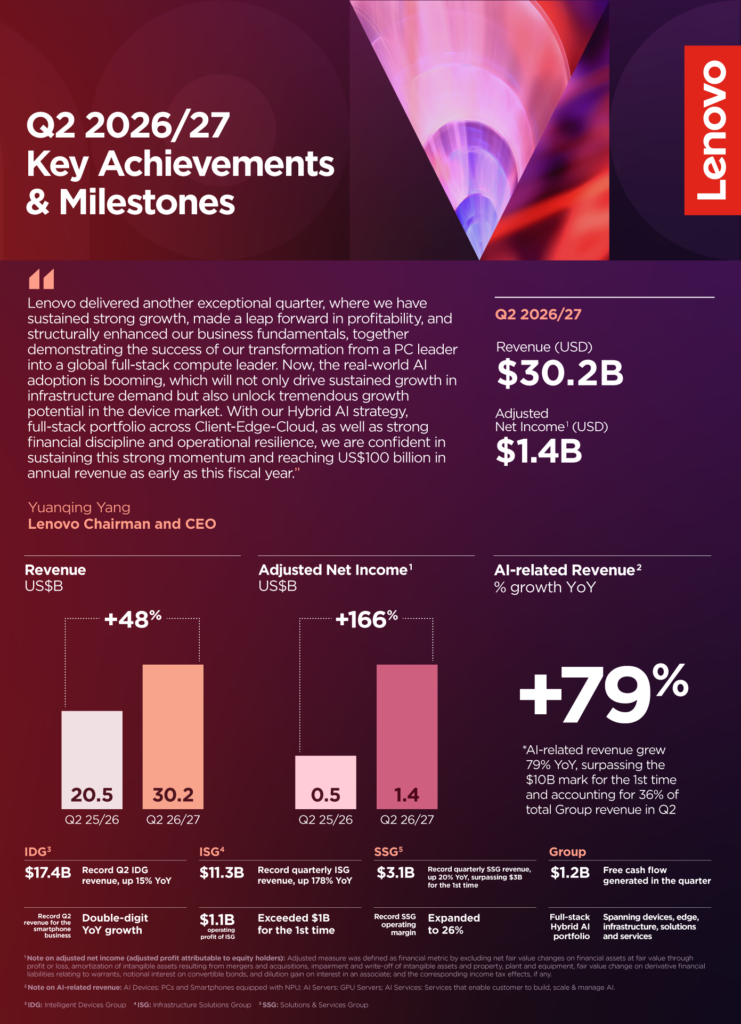
Five days before the sale began, Lenovo reported record quarterly revenue of $30.2 billion, up 48% from a year earlier. Its Infrastructure Solutions Group, which sells servers and storage, accounted for roughly three-quarters of the group’s $9.8 billion revenue increase. Infrastructure revenue rose 178% to $11.3 billion, and its operating margin reached a record 9.6%.
Why the device margin matters
Lenovo’s Intelligent Devices Group, which includes PCs and smartphones, generated $17.4 billion in revenue, up 15%, at a 7.1% operating margin. Applying the disclosed margins to segment revenue gives an estimated $1.24 billion in device operating profit, compared with $1.09 billion for infrastructure. Solutions and Services earned an estimated $810 million on $3.1 billion in revenue, reflecting its higher operating margin of 26%. These estimates exclude unallocated corporate costs and a group-level fair-value charge.
The size of the device business makes its margin particularly important: at September-quarter revenue, a decline from 7.1% to 6.1% would reduce quarterly operating profit by about $174 million. Lenovo’s chief financial officer has set a goal of a group net margin above 5%.
Device revenue grew even as IDC estimated that Lenovo’s PC shipments fell 22.6% year over year. Gartner put the global decline at 22.4%, to 55.4 million PCs. Lenovo sold a richer mix of configurations and premium machines, but its smartphone business also grew. The division’s revenue and PC shipment figures therefore do not establish how much Lenovo’s average PC selling price changed.
PC DRAM contract prices rose 18% to 23% in the September quarter, and TrendForce expected a further 13% to 18% increase in the December quarter. Memory accounts for a larger share of costs in lower-priced laptops. The $449.99 starting price does not by itself show that Lenovo’s device margin will fall: the outcome depends in part on how many discounted models it sells relative to higher-priced machines.
A reported loss alongside adjusted profit
Lenovo recorded a $640 million September-quarter loss under Hong Kong accounting standards, compared with a $340 million profit a year earlier. On its adjusted measure, profit attributable to shareholders rose 166% to $1.361 billion, equivalent to a 4.5% net margin.
A $1.9 billion non-cash fair-value charge explained most of the difference. Yicai reported that the charge related to derivative liabilities tied to warrants and convertible bonds issued as part of Lenovo’s partnership with Alat, a unit of Saudi Arabia’s Public Investment Fund. Lenovo sold Alat $2 billion of zero-coupon convertible bonds in 2024 at an initial conversion price of HK$10.42 a share. Its shares closed at HK$18.24 on November 24, about 75% above that price.
As Lenovo’s shares rose, the associated rights to acquire shares became more valuable, increasing the liability Lenovo recorded. Excluding the charge helps distinguish operating performance from that change in value, but it does not remove the potential dilution for existing shareholders. The holiday quarter poses a separate question: whether Lenovo can protect the margin on its largest source of segment operating profit while discounting laptops made with more expensive memory.