Nvidia shares rose 31% on November 23, 2026, after Jensen Huang was reinstated as chief executive. The stock accounted for more than a third of the S&P 500’s 4.7% gain. Yet the index recovered only half of the previous week’s loss, and the rally stalled just below 7,300. That level had been the floor of the index’s trading range for months; on Monday, it marked the limit of the rebound. The S&P 500 closed about 0.75% below its session high.
A rebound was already underway before the Nvidia news: S&P 500 futures were up more than 2% ahead of the announcement. In his November 24 market commentary, CNBC’s Mike Santoli wrote that the previous week’s widespread selling and rush to hedge against further losses had set the stage for a recovery. He reported that President Donald Trump had pressed Nvidia’s board to reinstate Huang and argued that Huang’s return amplified the rally as investors who had cut their exposure to AI stocks bought back in.
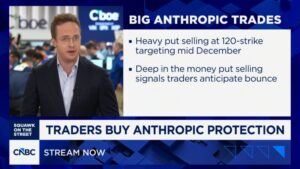
Anthropic was an exception, falling 1.4% in its third trading session since its initial public offering. Santoli suggested that a resurgent Nvidia, which backs open-weight AI models, could weaken the perceived advantage of Anthropic’s closed-model approach and its $200 billion in cash available for capital spending. He did not identify that as an established cause of the decline.
What the rebound says about a market bottom
The S&P 500 took 33 trading days to fall at least 10%, making this one of its dozen fastest corrections. Santoli noted that declines of that speed have more often been interruptions in bull markets than the start of prolonged downturns. But two corrections of similar speed, in November 2007 and February 2022, did usher in bear markets.
John Kolovos of Macro Risk Advisors saw some encouragement in how pessimistic investors had become. His firm’s sentiment model fell to its lowest reading since the 2025 market bottom, reaching levels comparable to those of the 2022 bear market. Kolovos said the six-month outlook had improved, but it remained unclear whether prices would recover quickly or revisit their lows first.
Bond yields presented a separate challenge that Huang’s return did not resolve. A Wellington Management comparison showed that the yield on 30-year inflation-protected Treasurys had climbed above the S&P 500’s free-cash-flow yield. Investors could earn a higher inflation-adjusted yield on long-term government debt than the cash companies generated relative to their share prices, potentially limiting how much investors would pay for stocks.
A revival in AI spending could also complicate expectations for easier Federal Reserve policy. Santoli posed that as a question, not a forecast: if stronger investment led to more borrowing and a hotter economy, the Fed might have less reason to ease. In his 2027 outlook, JPMorgan economist Bruce Kasman saw a related tension between strong earnings expectations and his forecast for above-potential growth, a sixth year of elevated inflation and a tightening labor market.