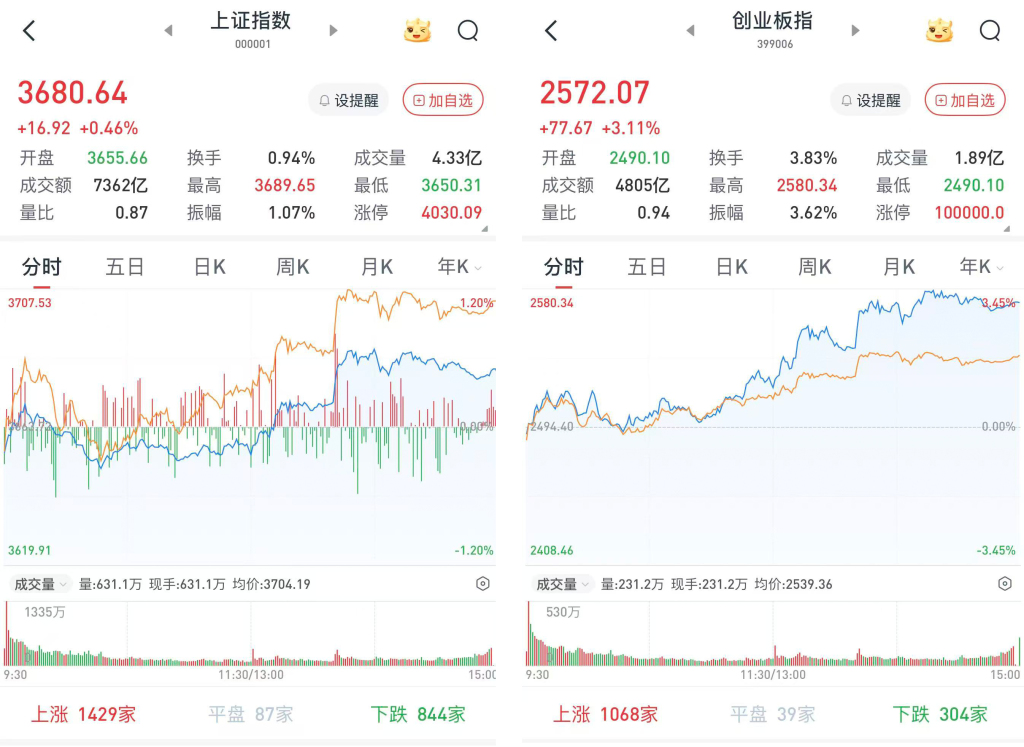
China’s three major A-share indexes opened lower together on November 11, 2026, then diverged. In the morning the Shanghai Composite was the weaker index, while the ChiNext fluctuated higher and extended its rise. AI hardware continued to gain in the afternoon and quickly helped lift the ChiNext by more than 3%.
At the close, the Shanghai Composite was up 0.46% at 3,680.64. The Shenzhen Component rose 1.32% to 11,389.74, and the ChiNext gained 3.11% to 2,572.07. Zhongji Innolight (300308) and Eoptolink (300502) each posted their largest single-day gain of the year. The report described the optical-module group nicknamed “Yi-Zhong-Tian”—Eoptolink, Zhongji Innolight and Tianfu Communication (300394)—as rising more than 13%. Banks turned lower late in the session, while baijiu, airlines and telecom operators were weak throughout the day.
Wind counted 3,537 gainers, 1,824 decliners and 215 unchanged stocks across the Shanghai and Shenzhen markets and the Beijing Stock Exchange. Shanghai and Shenzhen turnover totaled 1.6763 trillion yuan, 171.4 billion yuan more than the previous session’s 1.5049 trillion yuan. Shanghai turnover was 736.2 billion yuan, up 62.2 billion yuan from 674.0 billion yuan, and Shenzhen turnover was 940.1 billion yuan. Dazhihui VIP data showed 126 stocks up at least 9% and eight down at least 9%.
Sectors
Communications widened its afternoon gains and led the market. More than 10 stocks rose by the daily limit or more than 10%, including Taichen Guang (300570), Eoptolink (300502), Zhongji Innolight (300308), Shijia Photons (688313), Tianfu Communication (300394) and Liante Technology (301205).
Electronics was also among the stronger groups. More than 10 stocks rose by the limit or more than 10%, including Liyang Chip (688135), Yuanjie Technology (688498), Zhishang Technology (301486), Guangzhi Technology (300489), Qiutianwei (300939), Changguang Huaxin (688048) and Nanya New Materials (688519).
A CSC Financial research note said it is positive on 2027 opportunities as AI moves from model capability to practical use. On large models, it looks for continued scaling in pre-training, faster post-training and token volumes that support annual recurring revenue over the long term. On computing power, it said overseas cloud-service providers’ capital spending continues to grow, while a rising share of higher-margin PaaS and MaaS at Alibaba Cloud in China puts more weight on returns. It framed applications around being fast to deploy, large in market size and new in scenario.
Machinery and equipment also extended gains in the afternoon. More than 20 stocks rose by the limit or more than 10%, including Tongfei (300990), Ruidi Zhiqu (301596), Jept (688025), Tongye Technology (300960), Lianxun Instruments (688808) and Jiangsu Beiren (688218).
Food and beverage led the declines as liquor shares fell. ST Longda (002726) and Qingdao Food (001219) fell by the daily limit. Huangtai Liquor (000995), Jinshiyuan (603369), Gujing Gongjiu (000596) and Namchow Food (605339) fell more than 3%.
Agriculture, forestry, animal husbandry and fishery was among the weaker sectors. Baiyang (002696) fell 9%. Tianbang Food (002124), Wanxiang Denong (600371), Tianshan Biological (300313) and Jinjian Rice (600127) fell more than 2%. A Huatai Securities note said hog and piglet prices had again set lows, deepening the industry’s cash-flow losses. It said that could drive a larger-than-expected reduction in breeding-sow capacity and create room for later hog-price elasticity and persistence. With sector positioning still relatively low, Huatai reiterated what it called a positioning opportunity in hogs.
Non-bank financials were weak all day. Zhejiang Orient (600120), GF Securities (000776), Huatai Securities (601688), Founder Securities (601901) and Guosen Securities (002736) fell more than 1%.
Broker views into 2027
The following are research opinions reported by The Paper, not findings established by the market close.
Fu Jingtao, chief A-share investment strategist at Shenwan Hongyuan Research, wrote that A-shares are, over the long term, in a 2018-scale adjustment between two stages of advance. Over the medium term, he said a defensively dominated one-way decline is in its later stage and may be followed by a choppy phase of active bottom-up themes, which he called a necessary step toward a second stage of rising prices. In the near term, he said momentum for an oversold rebound is building and the balance between capital supply and demand is being rebuilt. He said a spring 2027 rally around year-end and the start of the year can be expected, and that an earlier oversold rebound would also be reasonable.
He said the period before March–April 2027 may be a window for an oversold rebound in which A-shares overall do not make new lows. After March–April 2027, he said this adjustment may reach a bottom area, followed by more structural opportunities, active themes and a possible new consensus. He looks to the second half of 2027 for a second stage of advance. He also said 2027 may bring a sharp turn from combined headwinds in the asset-allocation environment, industry trends and capital supply and demand to combined tailwinds. On that view, opportunities in the second half of 2027 may be better than in the first half, and investment returns in 2027 may be higher than in 2026.
Huatai Securities listed four areas to watch: the effect of incremental policy, including 550 billion yuan of unused local-government bond quota and 800 billion yuan of policy-based financial instruments; how financial regulators implement a State Council executive meeting’s proposal to improve mechanisms for stabilizing the capital market; external constraints, including domestic and diplomatic changes in the United States after the midterm elections and developments in the Middle East; and the December Central Economic Work Conference, which will set the tone for next year’s political and economic agenda, along with fourth-quarter signals from senior-level inspections and from fiscal and monetary policy.
Guosheng Securities said that, on buyback rules, the China Securities Regulatory Commission plans to add a share price falling below the IPO price as a case for market-support buybacks, remove the “listed for six months” requirement and restrictions on orders during the call auction, and require companies with surplus offering proceeds to carry out buybacks promptly when conditions are met. It said relending for share buybacks is becoming a standing arrangement and, together with the revised rules, provides funding and policy support for repurchases.
CITIC Securities said shareholder buying and company buybacks have increased markedly across the market. It said this indicates, to some extent, that after the rapid pullback current valuations have begun to attract listed companies and shareholders, while also providing some support to the market.
Tebon Securities said that, under a base case of continued growth-stabilization policy, stable valuations, tightly balanced liquidity and no systemic external change, the fourth quarter and the full year are likely to move in a wide N-shaped range. It said support would come from earnings actually materializing and from steady additions of capital, and that structural opportunities may significantly outnumber a broad rise in valuations. For allocation, it suggested a barbell of value blue chips and high-growth companies, with attention to elasticity from new narratives and to earnings certainty driven by competitiveness.
AVIC Securities said this phased repair may already have started. It said sentiment indicators show a low has appeared and that technology may be in the late stage of a second round of deleveraging. It said subsequent capital absorption and any marginal improvement in risk appetite should be tracked, and that clearer positive signals can be awaited before the later repair is pursued. Over the medium term, it expects AI applications to become a main theme under the broader AI industry trend.
Original article: The Paper